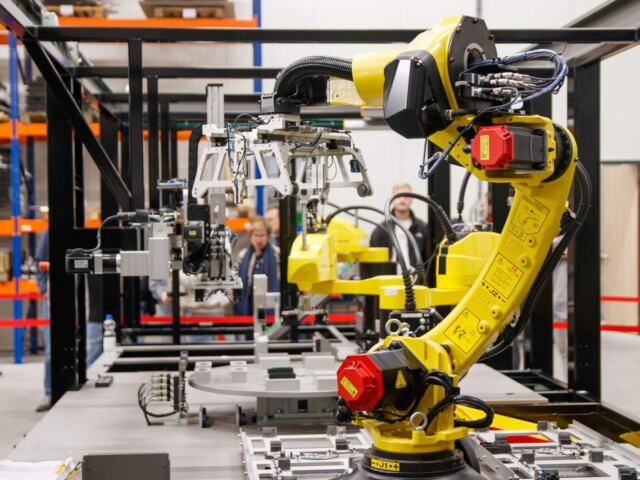
Wondering what is industrial IoT and whether it matters on your plant floor? It is the use of connected sensors, actuators and other devices to improve manufacturing and industrial processes, with data flowing to analytics.
| Item | Value |
|---|---|
| Core definition | Smart sensors, actuators and other devices used to enhance manufacturing and industrial processes |
| Industries named | Manufacturing, energy management, utilities, oil and gas |
| Consortium formed | 2014, as the Industrial Internet Consortium |
| Consortium renamed | 2020, to the Industry IoT Consortium |
| MQTT standard | ISO/IEC 20922 |
Figures can change, so check the sources, such as the TechTarget IIoT definition and the Industrial Monitor Direct IIoT reference guide, before you rely on them.
What the industrial internet of things means
According to TechTarget, the industrial internet of things (IIoT) is the use of smart sensors, actuators and other devices, such as radio frequency identification tags, to enhance manufacturing and industrial processes. It is also called the industrial internet.
It is used in manufacturing, energy management, utilities and oil and gas. The driving philosophy, in the same source’s words, is that smart machines are better than humans at capturing and analyzing data in real time.
In practice that means a pump, a press or a conveyor reports on its own condition, and the people running it see problems sooner. The same source says connected sensors and actuators let companies identify inefficiencies and problems sooner, saving time and money.
Where the idea came from
TechTarget says IIoT emerged from two initiatives: Industry 4.0 and 5.0. Industry 4.0, launched in 2011, established the foundation that is being realized in IIoT and other advanced industrial automation technologies.
Industry 4.0 is also called the fourth industrial revolution and focuses on digitization and automation of manufacturing and industrial processes. Industry 5.0, introduced in 2021, builds on those technologies and shifts the focus to human-centric innovation, sustainability and resilience.
The same source notes that in 2014 several technology companies, including AT&T, Cisco, General Electric, IBM and Intel, formed the Industrial Internet Consortium, which was rebranded as the Industry IoT Consortium in 2020.
IIoT is the data-gathering layer; the wider movement is explained in our piece on what is industry 4.0.
How the pieces connect
An IIoT setup is usually layered. Sensors feed controllers, an edge gateway translates and buffers data, and a platform stores and analyses it.
The Industrial Monitor Direct guide lists protocol options by layer:
- Sensor to edge: IO-Link, WirelessHART, Modbus RTU and Modbus TCP.
- Edge to PLC or RTU: EtherNet/IP, Profinet, Modbus TCP and OPC UA.
- Edge to cloud: MQTT, AMQP, HTTP/REST and OPC UA over TLS.
That guide describes MQTT as an OASIS standard (ISO/IEC 20922) lightweight publish/subscribe protocol designed for low-bandwidth, high-latency, or unreliable networks. It also says a gateway performs protocol translation, local buffering, edge analytics and network security.
The practical point is that older equipment rarely speaks the same language as cloud tools. A gateway bridges that gap without replacing the machine.

Where it is used in practice
TechTarget says that in an industrial setting IIoT is key to processes such as predictive maintenance, enhanced field service, energy management and asset tracking.
- Predictive maintenance: condition data is analysed so a team can act before a failure rather than after it.
- Field service: technicians see equipment status before they travel to a site.
- Energy management: named by TechTarget as one of the processes where IIoT is key.
- Asset tracking: tags and sensors show where tools, parts and products are.
Those alerts need somewhere to go. A maintenance system turns them into work orders, which is why it helps to understand what is a cmms alongside any sensor project.
How IIoT differs from traditional SCADA
Many plants already run SCADA, so IIoT is often an addition rather than a replacement. The Industrial Monitor Direct guide maps each traditional function to its IIoT equivalent.
| Function | Traditional SCADA | IIoT equivalent |
|---|---|---|
| Remote data acquisition | Modbus, DNP3 over serial, radio or cellular | MQTT over cellular or satellite |
| Historical trending | Historian (Wonderware InSQL, OSIsoft PI) | Cloud time-series database (InfluxDB, Timescale) |
| Web-based operator screen | Web thin client (WinCC WebUX, FactoryTalk ViewPoint) | Browser dashboard (Grafana, custom SPA) |
This mapping comes from the Industrial Monitor Direct IIoT reference guide; product names and practice change, so check it before you rely on it.
The pattern is that the job stays the same while the tools become more open and web-based. Your operators still need trends, alarms and a screen; what changes is where the data lives and how it travels.
The same guide notes that older protocols have a life cycle. For example, it says MAP, the Manufacturing Automation Protocol from the 1980s, was effectively abandoned by Y2K and replaced by TCP/IP Ethernet, while DeviceNet is still installed in legacy fleets but declining in new design.
That history is a useful warning. Before committing to any protocol or platform, check how widely it is supported and how long your suppliers plan to maintain it.
Security and other cautions
TechTarget points out that early on, manufacturers created IoT devices with little regard for security, which gave connected devices a reputation for being insecure. It adds that security is a bigger priority among device manufacturers than ever before.
It lists methods such as multifactor authentication and end-to-end encryption. Treat these as questions to put to any supplier, not as guarantees.
A gateway is not always needed either. Where your SCADA system already supports a protocol natively, an extra device may just add cost and another thing to maintain.
- Start with one use case, such as a few critical assets.
- Check which protocols your existing equipment already speaks.
- Ask how devices are authenticated and how data is encrypted.
- Plan who will act on the data, not only who will collect it.
Questions to ask before a pilot
A small pilot is one way to learn whether IIoT suits your site. Keep it small and measurable, and agree in advance what result counts as success.
- Pick one asset or line where unplanned stops are costly or hard to predict.
- List what data already exists in your PLCs, drives and meters before buying new sensors.
- Decide whether data stays on site, goes to the cloud, or both, and who owns it.
- Check that your network team and your operations team agree on access and security rules.
- Name the person who will respond to alerts, and what they are expected to do.
- Review the result against your starting point, then decide whether to widen it.
Notice that most of these steps are about people and process rather than hardware. Sensors are the easy part; acting on what they tell you is where value is made or lost.
Also be sceptical of broad claims about return on investment. Results depend on your equipment, your failure history and how quickly your team responds, so test on your own assets before projecting savings.
Fitting IIoT into your wider plans
IIoT rarely succeeds as a standalone gadget project. It works best as one step in a sequence that also covers data quality, maintenance processes and people.
For the bigger picture of ordering those steps, see our guide to digital transformation in manufacturing.
This site is independent and educational. It is not affiliated with any company or body named here and offers no consulting.
Frequently asked questions
Is IIoT the same as IoT?
Show answer
No. IIoT is the industrial side of IoT, aimed at manufacturing and similar processes rather than consumer devices.
Which industries use IIoT?
Show answer
TechTarget names manufacturing, energy management, utilities and oil and gas.
What is MQTT?
Show answer
The Industrial Monitor Direct guide calls it an OASIS standard (ISO/IEC 20922) lightweight publish/subscribe protocol for low-bandwidth or unreliable networks.
Do I always need an edge gateway?
Show answer
Not necessarily. If your existing systems already support the protocols you need, a gateway may add little.