Wondering what is Industry 4.0 and whether it matters to your plant? It is the shift to connected, data-driven manufacturing, where machines, sensors, software and people share information.
| Item | Value |
|---|---|
| Also known as | The fourth industrial revolution |
| Core technologies | IIoT, automation, AI, cloud computing and data analytics |
| Industry 3.0 focus | Digitization and automation of individual processes |
| Industry 4.0 focus | Connected, intelligent and data-driven industrial operations |
| First revolution began | Steam-powered mechanization in the late 18th century |
These points come from IBM’s Industry 4.0 overview. Definitions and technology lists change, so check the source before you rely on them.
This guide is part of our coverage of digital transformation in manufacturing.
The core idea behind Industry 4.0
Industry 4.0 refers to a broad trend toward digital transformation across manufacturing and other industries. It connects physical equipment with digital systems, sensors, data, AI and cloud technologies.
The aim is more intelligent and responsive operations. Instead of data sitting in one machine or department, information flows across the whole operation.
IBM says the approach brings new clarity, efficiency and optimization to industrial infrastructure. That allows improved production of a wider range of products and services.
It is not one product you buy. It is a direction of travel, made up of many smaller projects that each make a process more visible or more automatic.
How the four revolutions fit together
Industry 4.0 builds on earlier shifts in how things are made. Each one added a new capability, and the label helps explain what is new this time.
- First: water and steam power mechanized production, moving work from handcrafted labor to factory production.
- Second: electricity, new materials and the assembly line enabled large-scale mass production.
- Third: electronics, computerized systems and information technology automated industrial processes.
- Fourth: connected, data-driven operations built on IIoT, AI and cloud.
IBM notes that the third stage improved both efficiency and quality. Yet in that stage, data is often limited to specific machines, departments or systems.
The fourth stage aims to remove those silos. The difference is less about adding more automation and more about connecting what already exists.
Industry 3.0 versus Industry 4.0
A side-by-side view makes the shift clearer. The table below reflects the comparison in IBM’s overview.
- Industry 3.0 technologies: computers, PLCs, electronics and basic automation.
- Industry 4.0 technologies: IIoT, AI, machine learning, cloud computing, edge computing, digital twins and robotics.
- Data: in Industry 3.0 it is often limited to specific machines, departments or systems; Industry 4.0 connects machines, sensors, software and people.
IBM says Industry 4.0 builds on the automation introduced in Industry 3.0, such as programmable logic controllers (PLCs), robotics and stand-alone production. So it extends existing equipment rather than discarding it.
The question shifts from “is this machine automated?” to “can this machine share what it knows with the rest of the plant?” That is a different kind of project, and it often starts with data rather than hardware.
Think of an older line with a good PLC but no connection to scheduling or maintenance software. Its output is reliable, yet nobody outside the line can see what it is doing. Connecting it is the Industry 4.0 step.
Key technologies
IBM lists IIoT, automation, AI, cloud computing and data analytics as the main building blocks. It also names edge computing, digital twins and robotics.
- Industrial IoT: sensors and connected machines that report their own condition. Our guide on what is industrial iot covers this in depth.
- AI and machine learning: software that finds patterns in machine data, for example to support predictive maintenance.
- Cloud and edge computing: where data is stored and processed, centrally or close to the machine.
- Digital twins: virtual simulations of specific pieces of machinery.
- Robotics: automation that works with connected systems.
IBM also lists ERP software, CMMS software, cybersecurity tools and blockchain as part of the picture. No single plant needs all of them at once.
What it looks like on the shop floor
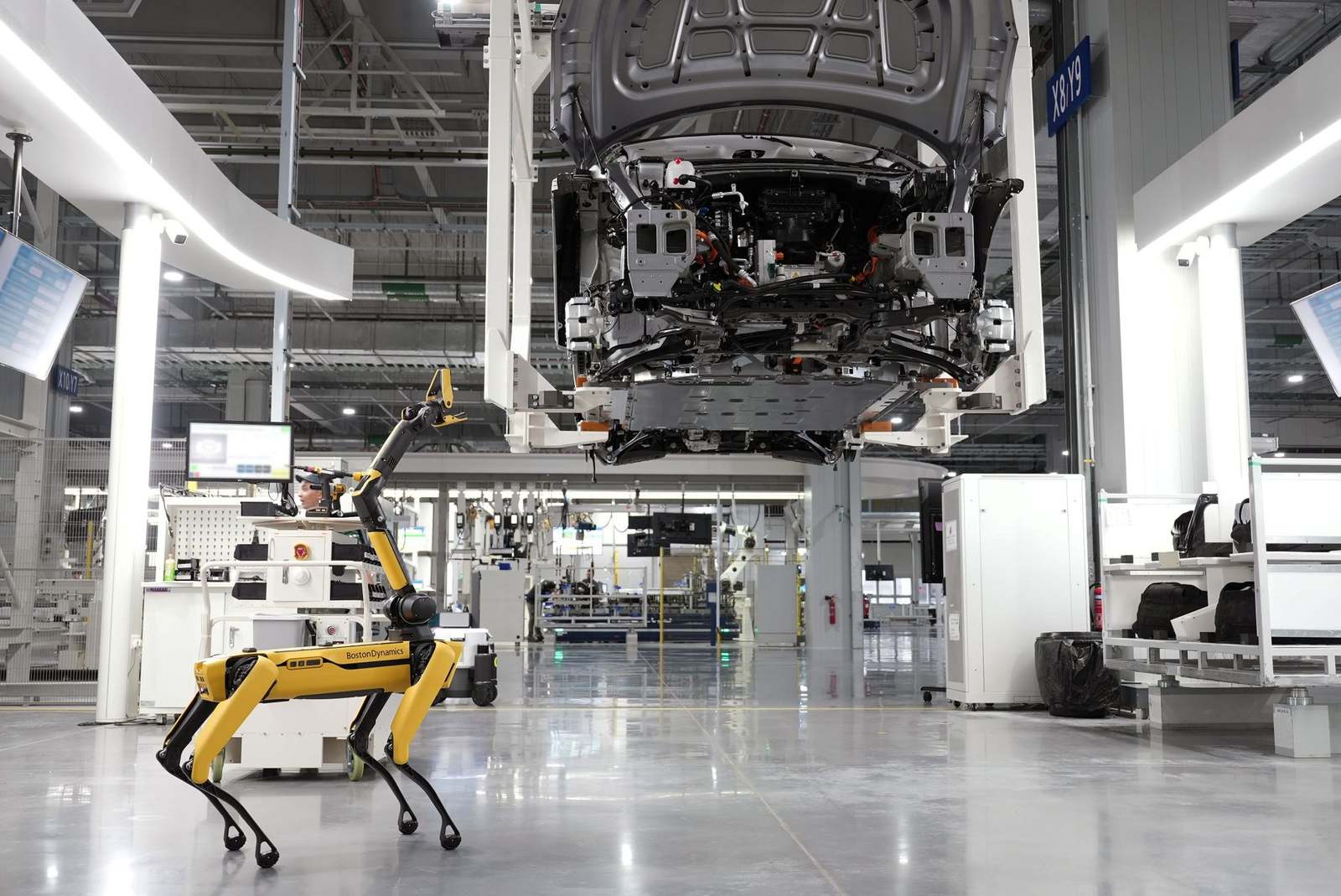
IBM ties Industry 4.0 closely to the smart factory: a manufacturing environment incorporating advanced sensors, embedded software, robotics and connected systems. These factories use big data collected by Internet of Things sensors.
The data then goes into enterprise resource planning software. This can increase information visibility and improve practices from predictive maintenance to supply chain management.
Digital twins and predictive maintenance
By tracking equipment down to the individual parts, manufacturers can build a virtual copy, called a digital twin. It can be run under unusual conditions or faster than real time.
That capability helps determine when the actual equipment is likely to break down or need repair. Teams can then plan predictive maintenance and avoid costly downtime.
IT and OT working together
Smart factories combine data analysis, integrated information technologies (IT) and operational technologies (OT), customizable smart manufacturing and supply chain management. IBM says close integration of IT and OT gives actionable visibility.
In practice, that means production data and business data are read together. For real-world cases, see these smart factory examples.
Better planning decisions
When combined with data from sales, inventory, human resources, warehousing and supply chain management, production data can support more informed decisions. IBM lists staffing, scheduling, capacity, raw-material availability and finished-goods delivery as examples.
Supply chains and smaller batches
IBM says transparent and efficient supply chains are essential to any industrial manufacturing operation. In a smart factory, IoT sensors, PLCs, robots, enterprise applications and workers can share relevant information across an integrated production environment.
That shared view also changes what a factory can make. By applying advanced simulation software with new materials, automation and additive manufacturing, smart factories can create smaller batches of specialized items at a cost-effective scale.
For a business that sells customized products, this is the practical appeal. Mass production, introduced in the second revolution, gives way to more flexible output.
Other technologies in the mix
IBM’s list goes beyond the headline items. It names generative AI, machine learning, cognitive computing, big data, data analytics, digital twins, digital threads, robotics, automation, additive manufacturing and 3D printing.
Not every item will suit every plant. A useful way to sort them is by the problem each one addresses:
- Seeing what is happening: sensors, IIoT and data analytics.
- Predicting what will happen: machine learning and digital twins.
- Acting on it: robotics, automation and additive manufacturing.
- Protecting it: cybersecurity tools and governance.
This grouping is our own reading aid, not an IBM framework. Use it to decide which problem to tackle first.
Risks to plan for
Greater connectivity creates new cybersecurity risks. IBM says security should account for connected assets, networks, edge devices, cloud applications, identity and access management, software updates and incident response.
Data quality matters too. Effective industrial AI programs require reliable data, strong cybersecurity controls and clear governance.
A sensible reading for a plant manager: connect first where the data is most valuable, and secure each new connection as you add it.
Frequently asked questions
Is Industry 4.0 the same as the fourth industrial revolution?
Show answer
Yes. IBM uses the two names for the same trend toward digital transformation in manufacturing.
How is it different from Industry 3.0?
Show answer
Industry 3.0 focused on digitizing and automating individual processes. Industry 4.0 focuses on connected, intelligent and data-driven operations.
Which technologies does it include?
Show answer
IIoT, automation, AI, cloud computing and data analytics, plus edge computing, digital twins and robotics.
What is a smart factory?
Show answer
A manufacturing environment incorporating advanced sensors, embedded software, robotics and connected systems, closely associated with Industry 4.0.
Does it bring risks?
Show answer
Yes. More connected equipment creates new cybersecurity risks that need controls and governance.